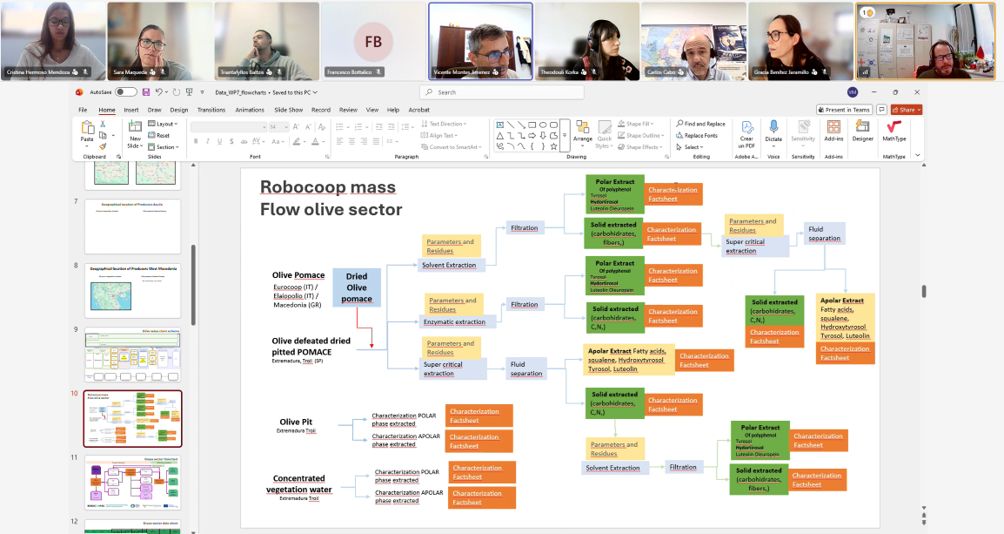
WP7 partners advance cross-regional cooperation and the integration of technical results, stakeholder engagement and business development.
9 November 2026 | ROBOCOOP-EU Project News
How can agricultural by-products become viable business opportunities for farmers, cooperatives and rural enterprises?
This question was central to the ROBOCOOP-EU Work Package 7 (WP7) Monthly Coordination Meeting, held online on 9 November 2026. Bringing together representatives from CluBE, CIHEAM Bari, the University of Extremadura (UEx), UCO and FPCTEX, the meeting focused on strengthening the connection between technological developments, regional Living Labs and cooperative business models.
The discussions marked another step in the project’s efforts to translate circular bioeconomy research into practical opportunities for agricultural value chains.
Three regional Living Labs: Building on stakeholder engagement
The meeting reviewed progress across the project’s three regional hubs in Apulia (Italy), Western Macedonia (Greece) and Extremadura (Spain).
In Apulia, CIHEAM Bari confirmed the completion of the third Living Lab workshop, which has contributed to exploring cooperative business opportunities and stakeholder perspectives on agricultural by-product valorisation.
Western Macedonia also reported the completion of three regional workshops, strengthening the participatory foundations for developing and assessing circular bioeconomy solutions.
Partners discussed the next round of regional workshops, provisionally envisaged for early 2027. Particular attention will be given to engaging primary producers, investors and other value-chain stakeholders, while ensuring that emerging technical results can be presented in accessible and relevant formats.
These activities are intended to help connect scientific innovation with the organisational, economic and territorial realities faced by agricultural cooperatives.
Four business models: From theoretical configurations to practical applicability
A major discussion concerned Deliverable D7.3 – Four Optimal Business Models, being developed by CluBE.
The deliverable examines four potential approaches to agricultural by-product valorisation:
Rather than treating these models as mutually exclusive solutions, partners emphasised the importance of assessing their potential combinations and suitability under different regional conditions.
Key considerations include biomass availability, investment requirements, governance arrangements, cooperation among economic actors, management capacity and decision-making processes.
The discussion also highlighted the importance of connecting the theoretical analysis with project evidence and Living Lab experiences, helping ensure that the resulting deliverable supports practical decision-making.
Regional business plans: Connecting technical evidence with investment opportunities
Progress on Deliverable D7.4 – Regional Business Plans was another central topic.
The University of Extremadura is developing the draft business-planning framework and identifying the technical and economic information required from contributing partners.
A priority is to strengthen coordination between the teams responsible for techno-economic analysis and regional business planning.
This work will help clarify how proposed valorisation pathways could be assessed in terms of feedstock availability, processing requirements, market opportunities, investment needs and operational feasibility.
Integrating technical results across the value chain
Partners also reviewed ongoing efforts to consolidate project results into a common evidence base for the three regional hubs.
The proposed approach brings together existing agricultural production processes, by-product streams, innovative processing pathways, resulting products, logistics, economic information and potential customers.
Harmonising technical terminology and value-chain information across work packages will be important for making these findings understandable and useful to producers, cooperatives, industry representatives and investors.
Strengthening communication and stakeholder participation
The meeting also underlined the importance of closer cooperation between WP7 and WP8, particularly in translating technical findings into accessible communication and stakeholder engagement materials.
CIHEAM Bari and the Apulia team will explore opportunities for further exchanges with local primary producers, potentially providing an approach that could be adapted across the other regional hubs.
By connecting research, business development and stakeholder engagement, ROBOCOOP-EU aims to support more inclusive and economically relevant circular bioeconomy pathways.
Looking ahead
The next phase of WP7 will focus on consolidating the four business-model analysis, progressing the regional business plans, coordinating technical contributions and preparing the next round of Living Lab activities.
The underlying ambition remains clear: to help agricultural cooperatives move beyond supplying raw biomass and explore opportunities to participate more actively in creating and capturing value from agricultural by-products.
For further information, visit www.robocoop-project.eu.
ROBOCOOP-EU – Circular Bioeconomy Business Models Owned by Agro-Cooperatives
Grant Agreement No. 101112407 | Supported by the Circular Bio-based Europe Joint Undertaking (CBE JU) and its members.